



Bigger isn't always better: choosing the right AI model
Eudata's tests compare GPT-5.6 with three open source models available through Xference's private inference infrastructure.
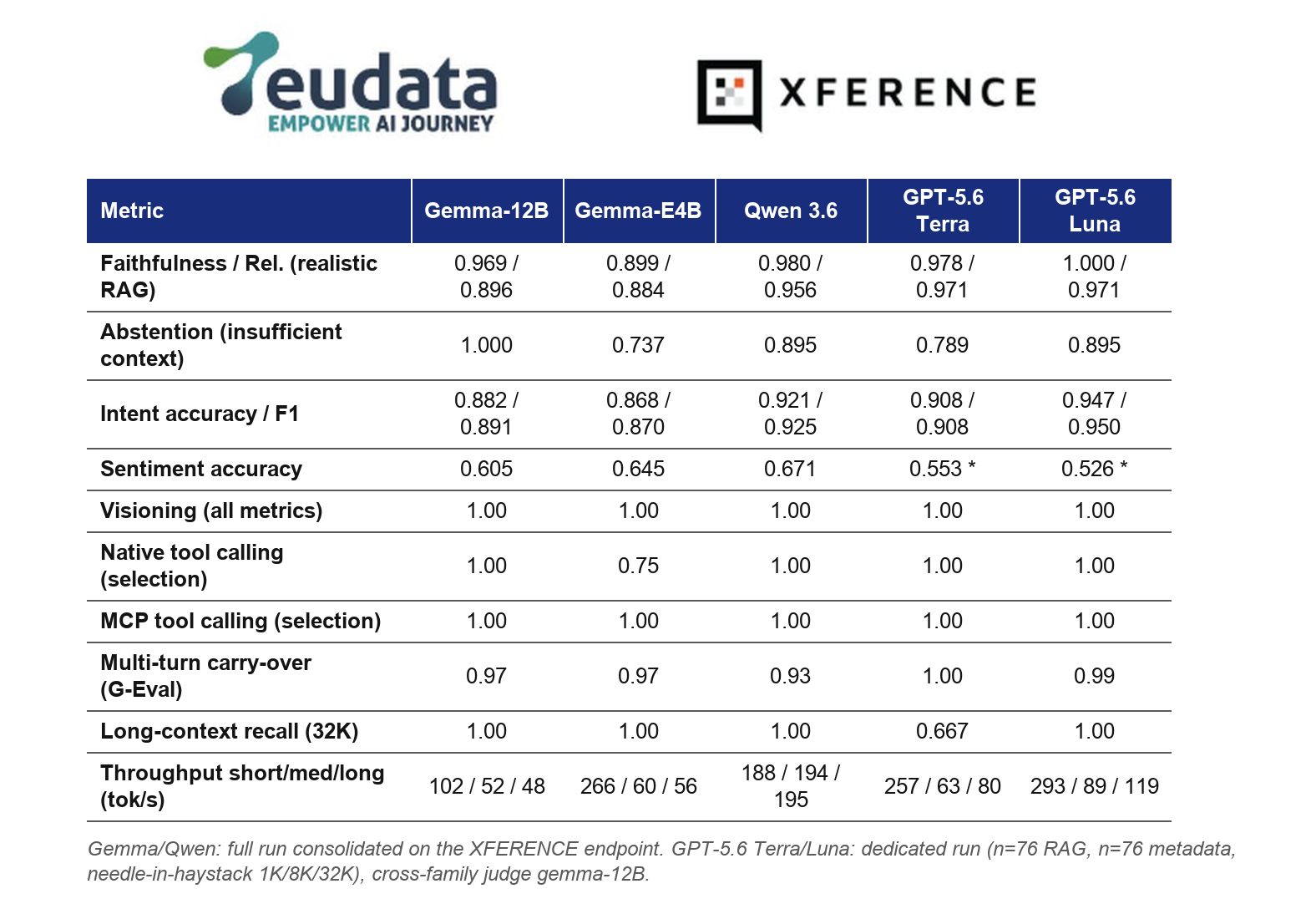
- Tests carried out by Eudata compare GPT-5.6 with three open source models available through Xference's private inference infrastructure.
- On key capabilities, the open source models achieve comparable results and, in sentiment analysis, even better ones than those obtained by GPT-5.6 Terra and GPT-5.6 Luna.
- Integrating Xference into ConvyAI brings model selection into the architecture of agentic workflows: for the same task, companies can choose the model based on the quality required, speed and the level of control over data.
Milan/Cagliari, October 8, 2026 – How big does an artificial intelligence model need to be to perform a given task effectively? A test campaign conducted by Eudata on agentic applications suggests that, for several typical enterprise workflow activities, model size is not necessarily the main factor determining the quality of the result.
The experiment, structured in two phases, first validated three open source models available through the Xference API and then compared them with OpenAI's GPT-5.6 using the same testbook and the same evaluation methodology. The results show comparable performance levels on several capabilities relevant to agentic applications and, on some metrics, better results from the open source models.
The integration of Xference as an officially available provider in ConvyAI, Eudata's platform for orchestrating AI in business processes, brings these models into the same environment where companies can use and combine different AI providers and technologies, choosing each time the approach best suited to the task, the data and the control requirements.
The Eudata test on customer care scenarios, comparing five models
The experiment was conducted directly by Eudata on the basis of an agentic application and developed in two phases.
The first covered the validation of three open source models exposed by the Xference platform: Gemma-12B, with about 12 billion parameters, Gemma-E4B, with about 4 billion effective parameters, and Qwen3.6, which has 35 billion parameters in total but activates about 3 billion for each word generated.
The models were put through a series of customer care scenarios in Italian and English, in the telco and utility sectors, with contexts of up to about 24,000 tokens. The evaluation was carried out using an LLM-as-a-judge methodology with cross-evaluation: each model assessed the answers of the other models, without assessing its own, thus reducing the risk of favorable self-evaluation.
The second phase added GPT-5.6 Terra and GPT-5.6 Luna to the same testbook, connected directly to the OpenAI APIs. To keep conditions comparable, Eudata used the same testbook and the same evaluation methodology and turned off GPT-5.6's reasoning function.
The benchmark looked at some of the most relevant capabilities for an agentic application:
- retrieval and quality of document-based answers (RAG)
- intent recognition
- sentiment analysis
- image and document understanding
- tool calling
- context and conversational memory management
- information retrieval within very long contexts.
The results: parity on operational capabilities, differences on individual metrics
The results show how different models can achieve similar results, or excel at specific capabilities.
Visioning and tool calling reach 100% for all five models tested. The ability to read images and documents, including synthetic images and real tax documents, reached a score of 1.00 for Gemma-12B, Gemma-E4B, Qwen3.6, GPT-5.6 Terra and GPT-5.6 Luna. The same result was recorded for tool calling through MCP, used to interact with external tools such as a billing system.
The metrics related to understanding and retrieving information also show substantial closeness between the models. For the quality of RAG answers (faithfulness), the three Xference models scored 0.97 for Gemma-12B, 0.90 for Gemma-E4B and 0.98 for Qwen3.6, against 0.98 for GPT-5.6 Terra and 1.00 for GPT-5.6 Luna. On intent recognition, the models used on the Xference platform fall between 0.87 and 0.92, while GPT-5.6 Terra and Luna reach 0.91 and 0.95 respectively.
The clearest result in favor of the open source models emerges in sentiment analysis, which is also the metric with the lowest scores across the whole group. Gemma-12B reaches 0.61, Gemma-E4B 0.65 and Qwen3.6 0.67, while GPT-5.6 Terra records 0.55 and GPT-5.6 Luna 0.53.
Another distinctive element concerns the ability to handle insufficient information without generating an answer not supported by the context. Gemma-12B recorded perfect abstention in the tests: when the available information was not sufficient, the model did not produce an invented answer. This behavior had already emerged in Eudata's V2 validation and was confirmed in the second phase of the comparison.
The main metrics compared
In the Eudata benchmark, GPT-5.6 Terra's value of 0.67 on retrieval in a 32K context is attributed to safety refusals recorded in the logs. The cases classified as retrieval failures were associated with the presence in the test of the phrase “secret code”, which triggered a refusal by the model, and not with a failure to retrieve the information.
Not one model for everything, but the right model for each task
The results therefore highlight an important point for enterprise AI adoption: the choice of model can be made according to the specific task, instead of assuming that the largest model available is necessarily the most suitable for every stage of a workflow.
This is particularly evident in speed. Gemma-E4B, with about 4 billion effective parameters, reached 266 tokens/s on short texts, making it the fastest of the three Xference models on this type of input. Qwen3.6, on the other hand, maintained a throughput between 188 and 195 tokens/s as text length varied, showing a more stable speed. GPT-5.6 Terra, in the same comparison, went from 257 to 80 tokens/s as document length increased.
Throughput is not directly equivalent to energy consumption or operating cost, which were not measured in the Eudata benchmark. However, the possibility of using models that activate a smaller number of parameters for each generation can have significant implications in terms of computational efficiency, especially when an application has to process large volumes of requests.
This is the case, in particular, with Qwen3.6, which has 35 billion parameters in total but activates about 3 billion for each word generated. In this scenario, choosing a compact model or an architecture that uses only part of the available parameters makes it possible to calibrate computing capacity to the task at hand, rather than systematically using larger models.
“These tests confirm for us an important principle: in enterprise AI there is not necessarily a single model that meets the need. We compared different models on the same tasks and saw that, on fundamental capabilities for agentic applications, the results can be very close, while on some metrics significant differences emerge. - says Sandro Parisi, CEO of Eudata. - ConvyAI was created precisely to let companies seize the opportunity to use AI to redesign their processes in an AI-centric way, orchestrating different technologies and models, keeping the ability to choose which technology to use depending on the specific use case, optimizing price and complying with compliance rules. The integration of Xference extends this possibility to private inference scenarios as well”.
Private AI inference: where data is processed matters as much as the model
The choice of model is not the only variable, however. For an enterprise application, where inference is run and what level of control the organization wants to keep over its own data also come into play.
In the test conducted by Eudata, the Xference APIs were delivered directly from Xference's infrastructure located in a data center in the Bergamo area. The benchmark data therefore concretely support the use of Xference models through a private inference infrastructure located in Italy.
Xference is designed precisely for this scenario: providing private AI inference through open source models, with infrastructure located in Italy and the option of on-premise deployment as well. In this way, for the use cases that require it, the organization can keep greater control over the environment in which prompts, data and responses are processed.
The possibility of running inference on dedicated infrastructure does not mean that an open source model must replace the large commercial ones. If anything, the aim is to widen the available options: a model can be selected based on the complexity of the task, the quality required, the processing volume, security requirements and the level of control desired.
“Xference was born with the idea that sovereignty means having the possibility to choose how and where to run AI. - says Andrea Pili, CEO and co-founder of Xference - The tests conducted by Eudata give us concrete evidence: on several fundamental capabilities for agentic applications, more compact open source models can achieve performance comparable to GPT-5.6 and, in the case of sentiment analysis, obtain better results in the benchmark. When the required level of quality can be reached with a more compact model, considerations of computational efficiency, infrastructure and data control also come into play”.
“Model selection” as part of enterprise AI architecture
The integration of Xference into ConvyAI therefore brings model selection into the very design of agentic workflows.
A customer care process, for example, can include different activities: intent recognition, retrieval of information from documents, sentiment classification, querying business systems, conversational memory management and generation of the final answer. It is not necessarily required that all these activities be entrusted to the same model. ConvyAI makes it possible to orchestrate different technologies and providers within the same environment, while the integration with Xference adds the possibility of using open source models through a private AI inference infrastructure.
The goal today, therefore, is to build workflows in which task, model and infrastructure are chosen consistently with the result required and the level of control needed, without being forced to choose a single model a priori.
Eudata
Eudata is the parent company of an ecosystem of companies specialized in digital experience, with over €12M in revenue in 2026. Having become a Benefit Corporation, it develops solutions based on AI, omnichannel and cloud technologies to transform the way companies interact with their customers. Eudata already generates over €3M in ARR, in constant and rapid growth, across over 150 medium, large and top enterprise customers in Italy and Europe. ConvyAI is Eudata's no-code enterprise platform that makes it possible to redesign and evolve processes in an AI-centric way, orchestrating models, agents, processes and data, and integrating different providers within a single governed and scalable environment. The platform supports Customer Experience, Employee Experience, Document Automation and agentic process applications.
Xference
Xference is an Italian inference provider offering a scalable private AI inference infrastructure using open source LLMs, high-performing and energy-efficient, able to harness the power of generative AI while guaranteeing the highest standards of privacy and control over one's own data. The infrastructure is entirely built and run in certified Italian data centers and is also available on-premise. Founded in 2025 in Cagliari by Andrea Pili, Michele Fadda and Francesca Audino, in its first year it raised €700,000 from strategic partners and high-profile angel investors and began production of its infrastructure. In April 2026 it officially opened an invitation-only beta to the first 100 selected early adopters.